
Class / Class Details

By - Super admin
2nd Mar, 2026 At 02:40 PM
14th Apr, 2026 At 03:20 PM
29 Hours 20 Min
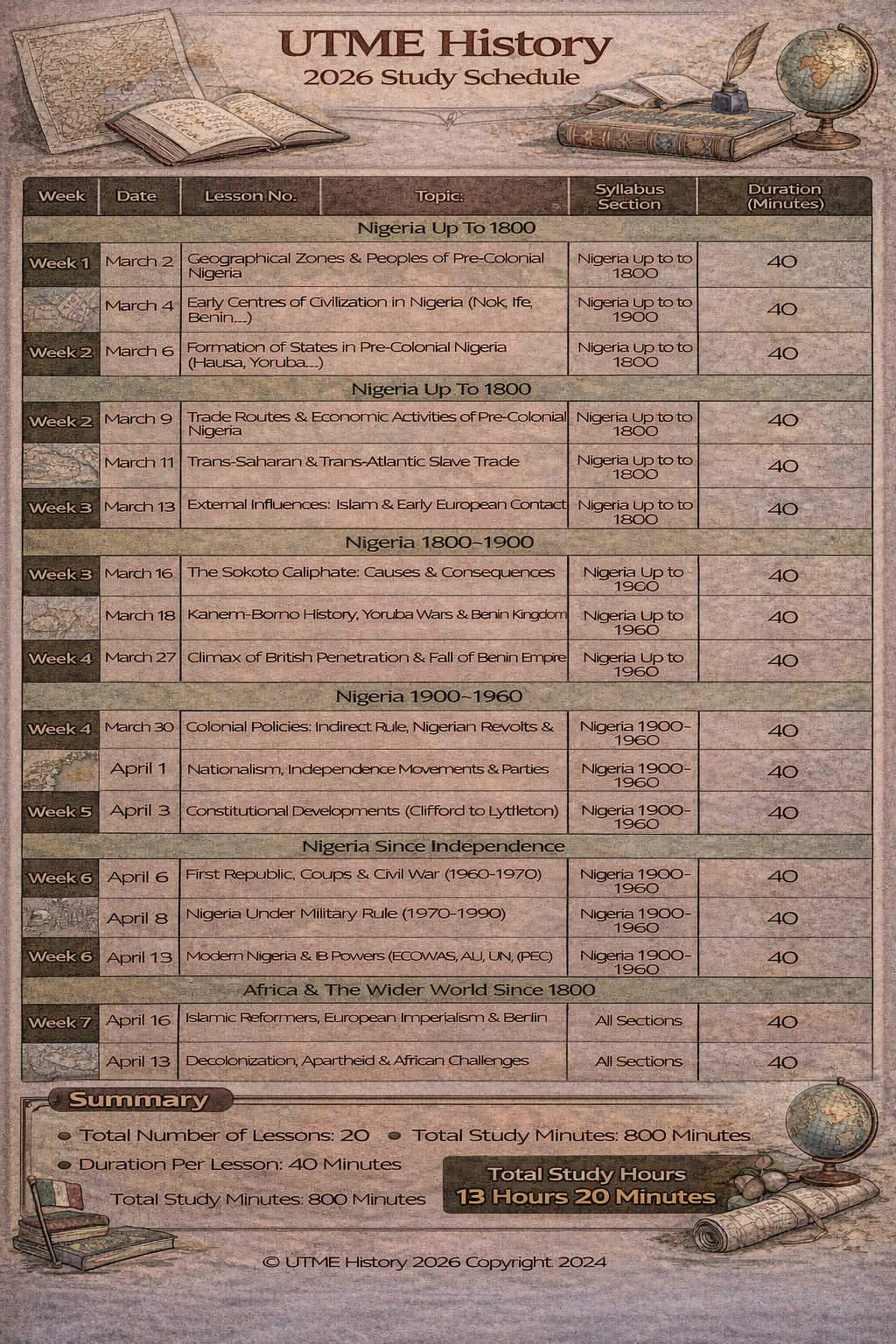
Our 2026 UTME History Preparation Program is a structured, analytical, and deeply contextual course carefully designed in strict alignment with the official UTME History syllabus .
The syllabus spans:
Nigeria up to 1800
Nigeria 1800–1900
Nigeria 1900–1960
Nigeria since Independence
Africa and the Wider World since 1800
Students are trained not just to memorize dates but to:
✔ Understand causes and consequences of events
✔ Analyze political and social developments
✔ Relate Nigerian history to African and global history
✔ Interpret modernization and development issues
✔ Connect the past to present-day realities
This is historical reasoning development — not rote memorization.
Parents trust this program because:
✅ It strictly follows the official syllabus objectives
✅ It strengthens analytical and critical thinking skills
✅ It builds national consciousness and civic awareness
✅ It prepares students for Law, Political Science, International Relations and related courses
✅ It develops evidence-based reasoning
History supports admission into:
Law
Political Science
International Relations
Public Administration
Education
Sociology
Development Studies
We ensure mastery of key areas such as:
Geographical zones and early peoples
Early centers of civilization (Nok, Ife, Benin, Igbo-Ukwu)
Formation of states (Hausa, Kanuri, Yoruba, Igbo, etc.)
Economic systems and trade routes
Trans-Saharan and Trans-Atlantic slave trade
External influences (Islam and European contact)
Sokoto Jihad and Caliphate
Kanem-Borno developments
Yoruba wars and 1886 treaty
European penetration and missionary activities
British conquest and resistance
Colonial rule and administration
Indirect rule and resistance movements
Constitutional developments (Clifford to Lyttleton)
Rise of nationalism
Road to independence
First Republic politics
Military coups and civil war
Gowon to Fourth Republic
Nigeria in ECOWAS, AU, UN and OPEC
Islamic reform movements
Imperialism and Berlin Conference
Colonial systems in Africa
Decolonization
Apartheid in South Africa
Nation-building challenges
Parents observe improved logical reasoning and stronger mock results.
Students love this program because:
📚 Events are explained chronologically and logically
🧠 Causes and consequences are simplified clearly
🌍 Nigerian history is connected to African and world history
🗂 Key constitutional developments are structured step-by-step
📝 Practice questions mirror UTME format
We simplify difficult areas such as:
Origins and migrations of Nigerian peoples
Sokoto Jihad administration
Colonial administrative structures
Indirect rule system
Nationalist movements
Civil war causes and effects
Military regimes and transitions
Berlin Conference implications
Apartheid and its dismantling
Nation-building challenges in Africa
Students move from confusion to confident historical interpretation.
This program stands out because:
🔹 Every topic aligns directly with the official syllabus
🔹 Emphasis is placed on cause-and-effect analysis
🔹 Nigerian history is integrated with African and global developments
🔹 Comparative historical interpretation is encouraged
🔹 Frequent UTME-style drills improve speed and accuracy
We train students to:
Identify key historical turning points
Compare political systems across periods
Analyze constitutional changes critically
Evaluate colonial and post-colonial policies
Interpret Africa’s place in global politics
Relate past events to present realities
This is structured historical intelligence — not memorization of dates.
This course is ideal for:
✔ SS3 students preparing for 2026 UTME
✔ Repeat candidates seeking higher aggregate
✔ Students pursuing Law or Social Sciences
✔ Students struggling with historical chronology
✔ High-performing students aiming for distinction
Whether beginner or advanced, this program strengthens analytical and interpretative competence.
By the end of this program, students will:
✅ Master Nigeria’s historical evolution
✅ Understand pre-colonial political systems
✅ Analyze colonial administration and resistance
✅ Evaluate nationalist movements and independence
✅ Interpret military and civilian regimes
✅ Assess Nigeria’s foreign relations
✅ Understand imperialism and decolonization in Africa
✅ Analyze Apartheid and African nation-building
✅ Answer UTME History questions faster and more accurately
Students become historically informed, analytical, and fully examination-ready.
History is more than the past — it shapes leadership, governance, and development.
A strong History score:
Boosts overall admission aggregate
Strengthens competitiveness for Law and Social Sciences
Develops analytical and critical thinking
Builds informed citizenship
Do not allow your child approach UTME History unprepared.
Enroll them in the 2026 UTME History Master Preparation Program today.
📌 Syllabus-Based Mastery
📌 Chronological & Analytical Framework
📌 Nigerian, African & Global Integration
📌 Mock Tests & Exam Strategy
📌 Proven Academic Improvement
Understand the past. Analyze the present. Shape the future. Score high. Secure admission.
As the Super Admin of our platform, I bring over a decade of experience in managing and leading digital transformation initiatives. My journey began in the tech industry as a developer, and I have since evolved into a strategic leader with a focus on innovation and operational excellence. I am passionate about leveraging technology to solve complex problems and drive organizational growth. Outside of work, I enjoy mentoring aspiring tech professionals and staying updated with the latest industry trends.
No Review found
 Pro
Pro
Pro
Pro





Discover Additional Learning Opportunities
Pro
Pro
 Pro
Pro
Pro
Pro
Pro
Pro
Pro
Pro